Best overall: an entire home with a securely enclosed yard. Best for dogs with limited mobility: a single-level rental. Best for short visits: a condo with a clearly permitted pet-relief route. For pet-friendly vacation rentals in La Quinta in 2026, choose the layout that fits your dog, then confirm the property's written pet rules before booking.
TL;DR
For pet-friendly vacation rentals La Quinta visitors should prioritize written pet permission, secure boundaries, and suitable indoor space.
An entire home with an enclosed yard is the best default for dogs that need private outdoor access.
A single-level rental is the strongest choice for dogs that struggle with stairs.
Use La Quinta Retreat as a planning starting point; confirm pet permission for the exact property before booking.
Why this matters
A pet-friendly label does not tell you whether your dog can stay alone, use the outdoor space, or move comfortably through the home. Those details determine whether a rental works for your trip.
Start with La Quinta Retreat when planning your stay, but treat the exact property's written rules as the booking standard. A destination website or search result is not a substitute for permission covering your animal and travel dates.
The best rental for your dog is the one whose rules and layout fit your actual routine. These rankings compare rental types, not verified individual properties; every recommendation depends on checking the specific listing.
What makes the best pet-friendly rental in La Quinta?
Use these criteria to evaluate a 2026 shortlist before comparing decorative features or outdoor amenities.
Written pet permission: Confirm the permitted species, number of animals, and any size or breed restrictions for the exact property.
Secure boundaries: Ask whether outdoor space is fully enclosed, whether gates latch, and whether pets share access with others.
Comfortable access: Check stairs, thresholds, flooring, and the route from the sleeping area to the permitted relief area.
Workable house rules: Read restrictions on unattended pets, furniture, barking, crates, and shared spaces.
Heat-aware outdoor access: Look for a practical shaded relief option and indoor comfort. Shade does not make hot surfaces safe.
A suitable human itinerary: Choose a home whose rules still work when your group goes out to eat or attends an event.
Do not let an attractive yard compensate for an incompatible unattended-pet rule. If your dog cannot accompany you and cannot remain at the property, the rental does not fit the trip.
Pet-friendly rental types at a glance
Entire home with an enclosed yard
Best for: Dogs needing private outdoor access
Standout feature to verify: Continuous enclosure and gates that latch
Key limitation: An enclosed yard is not automatically escape-proof
Single-level rental
Best for: Dogs with limited mobility
Standout feature to verify: Step-free access throughout the necessary route
Key limitation: Single-level interiors can still have entrance steps
Condo with a permitted relief route
Best for: Short visits with an accompanied dog
Standout feature to verify: Clear access from the unit to an approved outdoor area
Key limitation: Shared-space and building rules require separate checks
Multi-bedroom home with separate zones
Best for: Groups managing different routines
Standout feature to verify: Rooms and doors that support quiet separation
Key limitation: More space does not mean more pets are permitted
1. Entire home: best for private outdoor access
An entire home with a securely enclosed yard is the strongest default for travelers whose dogs need frequent outdoor access. You get a private indoor base and, when explicitly permitted, an outdoor area without a shared corridor between the two.
The deciding feature is the enclosure, not the phrase private yard. Ask for current photos showing the perimeter, gate bottoms, and access points rather than relying on a wide-angle patio photograph.
Entire-home pros:
Direct outdoor access can simplify supervised relief breaks.
Private space avoids shared indoor corridors.
A separate interior gives your group room to maintain familiar routines.
Entire-home cons:
Fence gaps, gates, or climbable objects can defeat an enclosure.
Yard access does not establish permission to leave a dog outside unattended.
A pool or other outdoor feature adds supervision requirements.
Best for: Dogs that benefit from private, supervised outdoor access.
Before booking in 2026, ask whether the yard is exclusively yours and whether maintenance staff or other guests use its gates. Confirm that the outdoor area is included in the pet permission, not merely accessible to human guests.
Verdict: Buy this rental type only after confirming both the enclosure and outdoor pet rules.
2. Single-level rental: best for dogs with limited mobility
A single-level rental puts essential rooms on the same floor. It is the best layout to investigate when your dog struggles with stairs, slippery surfaces, or frequent transitions between levels.
Do not stop at the floor-plan description. The route from parking to the entrance and from the sleeping area to the relief area matters just as much as the interior.
Single-level rental pros:
Essential spaces can sit along a straightforward route.
Fewer interior stairs reduce the need to carry a dog between rooms.
A nearby permitted relief area can simplify overnight breaks.
Single-level rental cons:
Entrance steps can remain even when the interior has no stairs.
Smooth flooring can be difficult for some dogs.
A long outdoor route can undermine an otherwise suitable layout.
Best for: Senior dogs and dogs whose mobility needs make stairs impractical.
Request photographs of thresholds and access routes. Describe the actual limitation rather than asking whether the home is generally accessible; a host needs to know whether you are concerned about steps, footing, distance, or all three.
Verdict: Buy the single-level option when the entire necessary route fits your dog's mobility.
3. Condo: best for short visits with an accompanied dog
A condo is a useful option when you plan to keep your dog with you and do not need private outdoor space. Its suitability depends on the route outside and the rules governing shared areas.
Check both property permission and any applicable building or community requirements. Permission inside the unit does not answer where your dog can walk, relieve itself, or wait with you outside.
Condo pros:
A compact layout can suit a short stay without unused rooms.
A clearly designated relief area gives you a defined outdoor routine.
A suitable unit can work for travelers who do not need a yard.
Condo cons:
Corridors, entrances, and outdoor routes can involve close encounters with other dogs.
Relief breaks can require stairs or an elevator.
Community restrictions can limit otherwise appealing shared amenities.
Best for: Short visits where your dog remains accompanied and handles shared spaces comfortably.
For a 2026 condo stay, ask where the approved relief area is relative to the actual unit. Also check whether your dog can avoid busy shared entrances if close encounters are difficult.
Verdict: Hold until the building rules and relief route are clear; skip if shared access conflicts with your dog's needs.
4. Multi-bedroom home: best for groups with different routines
A multi-bedroom home is the strongest layout to investigate when some travelers want quiet while others stay active. Separate rooms can also give a dog a permitted retreat from group activity.
Bedrooms alone are not enough. Check whether doors, room placement, and the permitted pet areas support the separation you need.
Multi-bedroom home pros:
Separate rooms can support different sleeping schedules.
A quiet permitted room gives your dog somewhere away from activity.
A suitable layout helps organize arrivals, meals, and supervised pet time.
Multi-bedroom home cons:
More bedrooms do not establish permission for additional animals.
Open-plan common areas can limit useful separation.
Groups still need an explicit plan for who supervises the dog.
Best for: Families or friend groups coordinating different activities around a pet's routine.
Agree on supervision before booking. If everyone plans to leave together, extra bedrooms do not solve an unattended-pet restriction.
Verdict: Buy for useful separation, not room count alone.
How these rental types are ranked
The ranking puts permission, secure access, mobility, and workable routines ahead of appearance. An entire home with an enclosed yard is the default because private outdoor access directly serves the needs of many dog-owning travelers; the other options win when a particular constraint matters more.
This is a decision framework, not a property inspection or a claim that a named rental meets these conditions. For your 2026 booking, the exact listing and written host confirmation remain the deciding evidence.
Check the property before you commit
Use this sequence to turn a promising listing into a clear decision. Keep the answers in the booking conversation so you can refer back to them.
Pet permission
Describe your animal accurately and ask whether it is permitted at the exact property for your dates. Include the number of pets and any details requested by the host.
Do not assume permission from an old review, a photograph containing a dog, or a broad search filter. Ask for 1 written reply that addresses your actual booking.
Access route
Ask to see the route between the entrance, sleeping space, and permitted outdoor area. Check gates, steps, shared passages, and surfaces your dog must cross.
A useful question is whether that route stays within your exclusive space or passes through a shared area. The answer separates a convenient floor plan from a workable pet routine.
House rules
Obtain 2 separate confirmations: that your pet is accepted, and that your planned daily routine is permitted. One does not imply the other.
Ask directly about unattended pets, crates, furniture, barking, cleanup, and outdoor supervision. Resolve conflicts before making the reservation.
Daily schedule
Match the rules to your actual itinerary, including meals out and events. If pets cannot stay alone, assign a companion or choose activities that accommodate the dog.
Use these 4 booking checks in order rather than treating pet permission as the final step. Permission starts the evaluation; the routine finishes it.
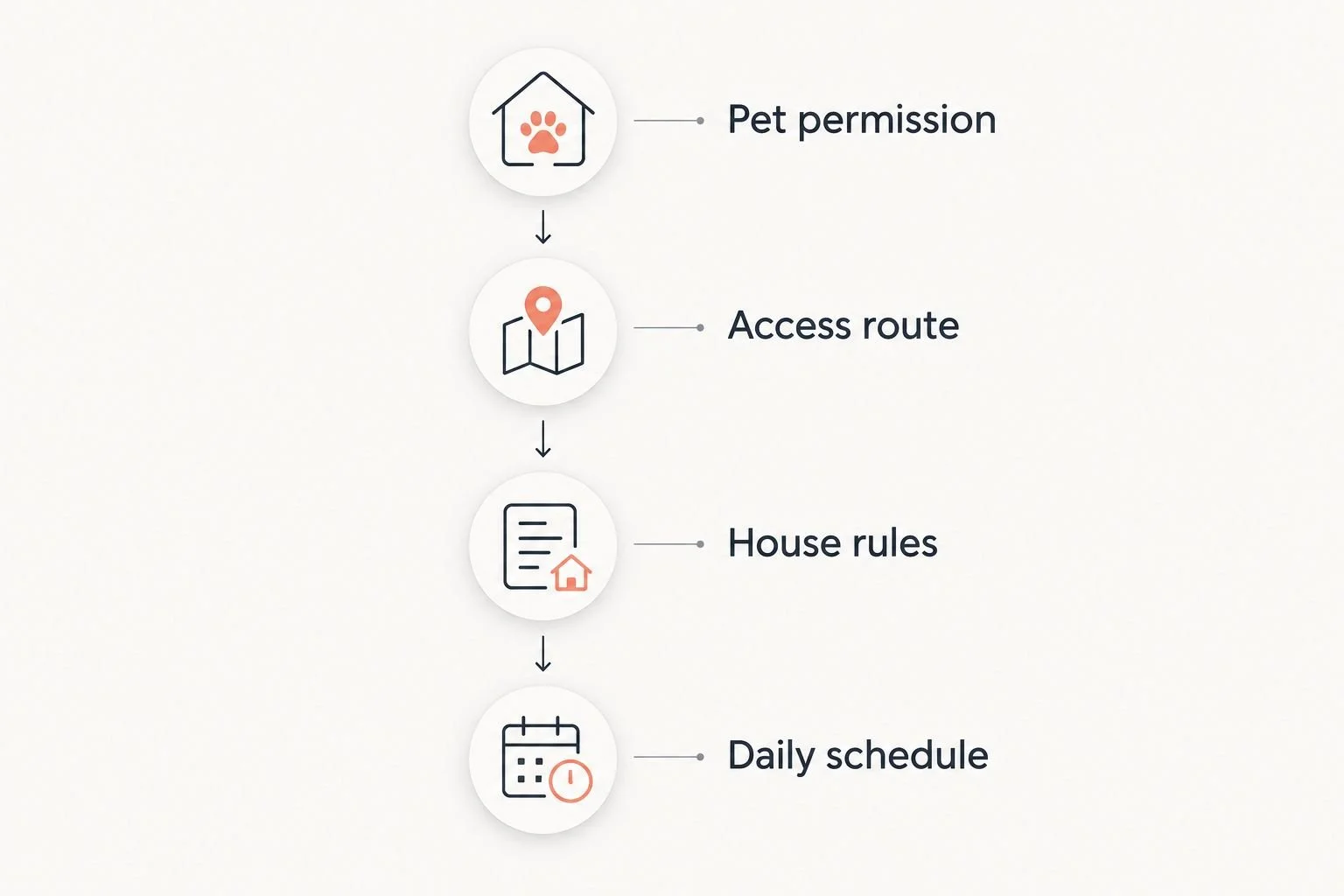
Confirm permission first, then check whether the property works for your routine.
Which pet-friendly rental should you choose?
Choose an entire home with a confirmed enclosed yard unless mobility, shared-space comfort, or group routines make another layout a better fit. A shorter shortlist built around those constraints is more useful than a long list of attractive properties with unclear rules.
La Quinta Retreat belongs in your destination planning, while the exact property's written pet permission belongs in your booking decision. Keep those roles separate when reviewing pet-friendly vacation rentals in La Quinta.
For 2026 travel, save the listing description and the host's replies together. Recheck any point that remains ambiguous before you commit.
FAQ
What's the best type of pet-friendly vacation rental in La Quinta?
An entire home with a confirmed enclosed yard is the best default for dogs needing private outdoor access. Choose a different layout when mobility needs, shared-space comfort, or group routines matter more.
Does a pet-friendly listing mean every dog is allowed?
No. Confirm that your specific dog meets the exact property's rules, including any restrictions on animal type, number, size, or breed. Get permission in writing before booking.
Is a private yard the same as a fenced yard?
No. Private describes who uses the space, while enclosed describes its boundaries. Ask for current perimeter and gate photos, and supervise your dog outside.
Can I leave my dog alone in a La Quinta vacation rental?
Only if the property's rules permit it. Ask about unattended-pet and crate requirements, then build your itinerary around the written answer.
Is a condo or an entire home better for a dog?
An entire home suits dogs needing private outdoor access; a condo suits dogs comfortable with shared routes when the building permits them. Compare the actual relief route and house rules rather than choosing by property type alone.
What should I check for an older dog?
Check the complete route from arrival to the sleeping and relief areas. Entrance steps, thresholds, slippery floors, and outdoor distance matter even in a single-level rental.
How should I use La Quinta Retreat to plan a pet-friendly stay?
Use La Quinta Retreat for destination planning, then verify pet permission and practical requirements for the exact property you are considering. Do not treat a general destination reference as confirmation that a particular animal is accepted.
One last thing
Ask one question that connects the house rules to your trip: Does this property permit the routine my dog will actually follow? Then describe that routine, including outings, rest periods, relief breaks, and time without you.
That answer is more useful than another patio photo. A rental that accepts your dog but prevents your planned itinerary is the wrong rental.