Best overall: a single home that accommodates your whole reunion comfortably. Best for independent households: nearby homes with a clearly agreed gathering plan. Best budget approach: a compact base home, but only when the complete trip quote beats the alternatives. This 2026 guide ranks configurations for La Quinta vacation home rentals for family reunions, not individual properties.
TL;DR
For La Quinta vacation home rentals for family reunions, choose sleeping arrangements before amenities.
Use La Quinta Retreat as a starting point; confirm the property's occupancy and gathering rules before committing.
Nearby homes suit independent households, but permission to gather at one property needs separate confirmation.
Compare family reunion rentals by bedrooms, bathrooms, access, supervision, and the complete booking terms.
Why this matters
The best reunion rental fits both your overnight group and your daytime gathering. Those are separate requirements: permission to sleep at a property does not establish permission to host additional relatives there.
Start your shortlist with La Quinta Retreat, then assess each candidate against the same household requirements. For your 2026 reunion, settle the guest list before choosing a pool, a view, or a particular neighborhood.
A useful shortlist answers practical questions. Where will grandparents sleep? Can parents hear their children at night? Where does everyone eat if the outdoor plan changes? Attractive photographs do not answer those questions.
What makes the best family reunion rental
Use these criteria before comparing homes. Treat a failed essential requirement as a reason to reject the property, not something an appealing amenity cancels out.
Sleeping privacy: Assign actual beds to named guests. Distinguish enclosed bedrooms from shared sleeping areas, and agree on those arrangements before booking.
Gathering permission: Confirm whether the proposed reunion is permitted, including visiting relatives who will not stay overnight. Describe the gathering accurately rather than asking only whether the home is family-friendly.
Bathroom access: Check bathroom placement, not just the total. A bathroom reached through someone else's bedroom creates a different arrangement from one opening onto a hallway.
Mobility access: Verify the route from parking to the entrance, bedroom, bathroom, and gathering area. A single-level description does not establish step-free access.
Supervision: Check pool access, bedroom separation, outdoor boundaries, and sightlines. Assign adult supervision explicitly; do not build the plan around a property's description alone.
Household logistics: Establish meal arrangements, quiet spaces, transport, and who handles communication with the host. A home should support your reunion routine without requiring constant negotiation.
Rental configurations at a glance
These are decision categories, not verified property listings. Choose the row that solves your hardest constraint first, then compare individual homes within it.
Single gathering home
Best for: Families prioritizing time together
Standout planning advantage: One address for approved shared activities
Key limitation: Privacy depends on the actual bedroom layout
Nearby separate homes
Best for: Independent households
Standout planning advantage: Separate routines and sleeping spaces
Key limitation: Gathering permission must be checked separately
Single-level home
Best for: Relatives who need fewer level changes
Standout planning advantage: A layout you can assess for a continuous accessible route
Key limitation: Single-level does not mean accessible
Home with separated sleeping zones
Best for: Families with young children
Standout planning advantage: A chance to separate bedtime from conversation
Key limitation: Separation can complicate supervision
Compact base home
Best for: Families keeping the stay simple
Standout planning advantage: Concentrates the rental on essential overnight needs
Key limitation: Full-family activities need another permitted setting
1. Single gathering home: best for staying together
A single gathering home puts your overnight group at one address. Choose this configuration when shared breakfasts, conversations, and time between outings are central to the reunion.
The deciding detail is usable space, not the largest advertised guest count. Check where everyone sits, where luggage goes, and whether someone must surrender a shared room each night to create a bed.
Single gathering home pros:
Shared activities do not require travel between accommodations.
Meal coordination stays at one address.
You can assess the overnight group against one property's rules.
Single gathering home cons:
Different sleep schedules share the same walls and common areas.
A sleeping-capacity figure does not establish comfortable seating or dining space.
One unsuitable bedroom arrangement affects the entire booking.
For a 2026 reunion, ask for the bed configuration and gathering rules before distributing the listing to relatives. Otherwise, families can become attached to a home that fails a basic requirement.
Best for: Families whose main priority is spending unstructured time together.
Verdict: Buy this configuration when every household accepts its assigned sleeping space and the gathering is permitted.
2. Nearby separate homes: best for independent households
Nearby homes let each household manage its own bedtime, breakfast, and downtime. This configuration suits relatives who want shared activities without sharing every domestic routine.
Do not confuse nearby with convenient. Compare actual entrances, walking routes, parking arrangements, and the transport needs of the least mobile person in your group.
Nearby separate homes pros:
Households retain separate sleeping and living spaces.
Early risers and late sleepers can keep different routines.
Families can choose layouts around their own overnight needs.
Nearby separate homes cons:
Reservations and host communications require coordination.
Gathering everyone at one rental needs explicit permission.
A route that suits adults might not suit children or mobility aids.
If you use 2 homes, identify the gathering location before booking either one. Send both hosts an accurate account of who stays where and where relatives intend to meet.
Best for: Independent households that prefer planned meetups to continuous togetherness.
Verdict: Hold until the gathering location, route, and separate booking terms all work.
3. Single-level home: best for fewer level changes
A single-level home is a useful starting configuration when stairs would disrupt someone's stay. The important test is whether that person can use the necessary spaces, not whether the listing uses an accessibility label.
Request specific information about thresholds, doorways, bathroom access, and the approach from parking. Match the answers to the relative's actual requirements.
Single-level home pros:
The main living areas can be assessed without planning around an internal staircase.
Bedroom and bathroom routes are easier to discuss as one connected layout.
You can prioritize access before optional amenities.
Single-level home cons:
Entrance steps and raised thresholds can remain.
Bathrooms can be unsuitable despite a level floor plan.
Outdoor gathering areas require their own access check.
For your 2026 shortlist, have the person using the route review the details directly where possible. Another relative's impression of what looks manageable is not an adequate substitute.
Best for: Families whose reunion depends on reducing level changes for a particular guest.
Verdict: Hold until the essential route and bathroom arrangements meet that guest's requirements.
4. Separated sleeping zones: best for young children's bedtimes
A home with separated sleeping zones gives families a layout to assess for quieter bedtimes. Choose it when adults want to continue talking after children settle down.
Separation is a trade-off, not an automatic benefit. Parents need to understand the distance, doors, and routes between their own sleeping space and their children's rooms.
Separated sleeping zones pros:
Bedrooms can be allocated around bedtime routines.
Adult conversation can be planned away from children's rooms.
Households can agree on quiet areas before arrival.
Separated sleeping zones cons:
Greater separation can make supervision harder.
Photographs do not establish how sound travels.
A distant bedroom is unsuitable if a child needs close overnight support.
Ask for a floor plan or a clear room-by-room explanation. Then assign bedrooms before booking rather than leaving families to negotiate the preferred rooms at arrival.
Best for: Parents who need a deliberate bedtime arrangement alongside shared family time.
Verdict: Buy this configuration when bedroom separation supports, rather than complicates, supervision.
5. Compact base home: best for a simpler overnight stay
A compact base home focuses on sleeping and essential household needs while reunion activities happen elsewhere. Consider it when your relatives already have a suitable, permitted gathering location.
This is the budget approach to compare, not an automatic saving. Judge the complete trip quote and practical requirements rather than assuming a smaller rental wins.
Compact base home pros:
You can prioritize necessary beds over unused gathering space.
A separate meeting location keeps the overnight home focused on rest.
Families can assess essential requirements without chasing extra amenities.
Compact base home cons:
Transport becomes part of the reunion plan.
Meals and shared activities need another suitable setting.
Additional arrangements can erase the simplicity you wanted.
Assign every sleeper before accepting this option. If a shared room becomes an overnight bedroom, decide when it stops being available to everyone else.
Best for: Families with an established gathering venue who want straightforward overnight accommodation.
Verdict: Buy this configuration only when the full-trip comparison and separate gathering plan both work.
How the configurations are ranked
The order prioritizes shared family time first, then distinct constraints: household independence, mobility, children's bedtimes, and a simpler overnight base. It does not rank named properties or claim that one layout suits every reunion.
Use La Quinta Retreat in your family reunion rental search with those constraints already written down. Reject a failed essential requirement before comparing optional amenities. A better-looking pool does not resolve an unsuitable sleeping assignment.
Turn the shortlist into a booking decision
Use this sequence for your 2026 planning. Keep the answers in a shared document so relatives evaluate the same arrangement rather than different impressions of a listing.
Guest list
Separate overnight guests from daytime visitors. For a 3-night stay, record which nights each person actually sleeps at the property; attendance can change during the reunion.
Room assignments
Give every overnight guest an agreed bed. If a household needs 1 enclosed bedroom for its children, treat that as a requirement rather than counting an unspecified shared sleeping space as equivalent.
Host confirmation
Describe the proposed use: overnight group, visiting relatives, meals, and any planned gathering. Ask for written confirmation of the applicable rules before committing.
Shared plan
Assign responsibility for meals, transport, supervision, and host communication. Share the relevant booking terms with each household rather than leaving the organizer as the only person who understands them.
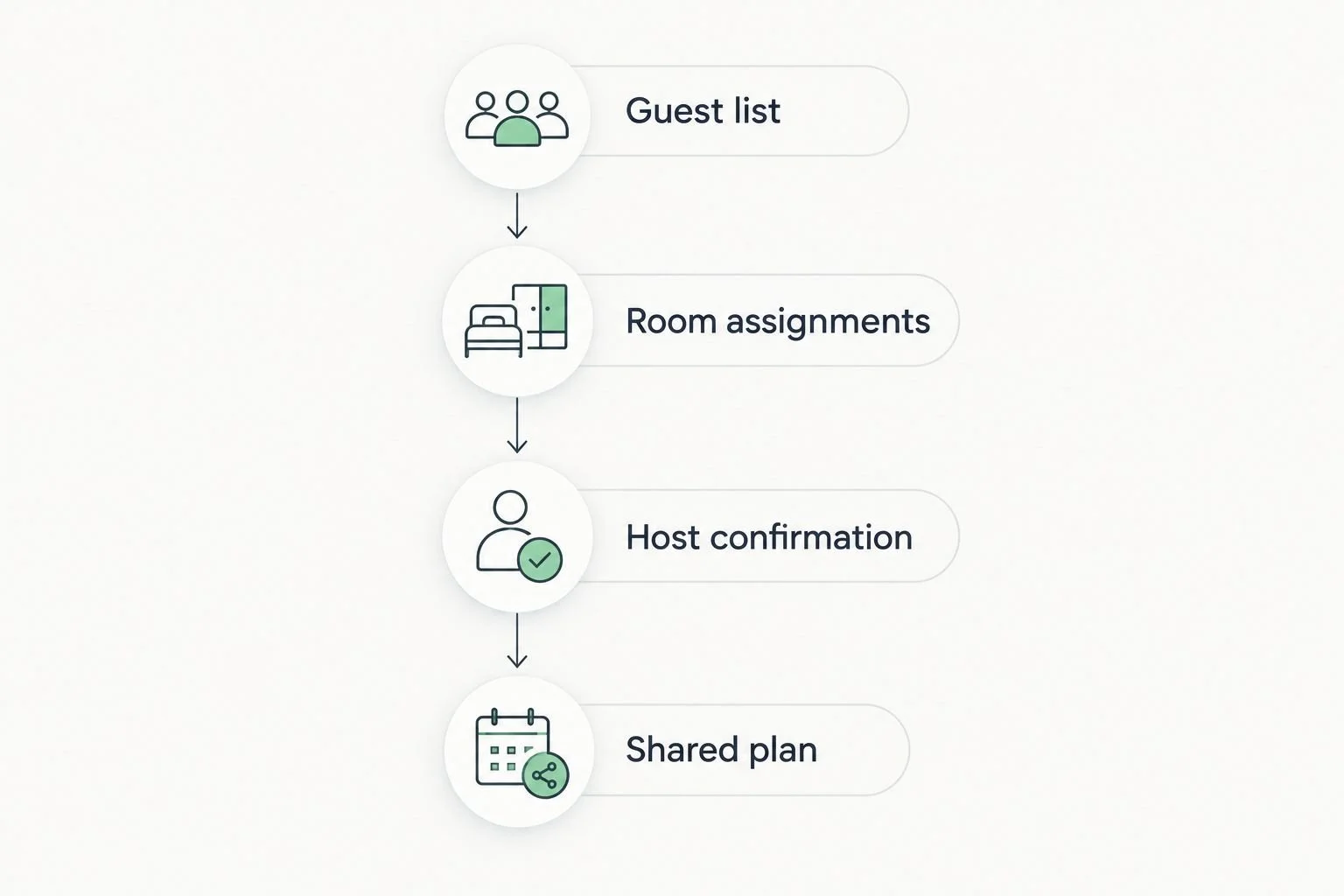
Settle the guest list and room assignments before asking the host to confirm your reunion plan.
A booking decision should now be straightforward: either the proposed stay meets the requirements or it does not. Keep a second configuration in consideration until the first one passes every essential check.
Which rental configuration should you choose?
Choose a single gathering home by default when togetherness is the point of the trip. Switch to nearby homes when independent routines matter more, or prioritize a verified access route when one relative's mobility determines whether the reunion works.
La Quinta Retreat belongs on your family reunion rental shortlist; the final choice belongs to the property details and your household requirements. Before booking for 2026, resolve any disagreement about sleeping spaces, visitors, or the gathering location.
FAQ
What's the best type of La Quinta vacation rental for a family reunion?
A single gathering home is the default choice when your priority is shared time at one address. Choose it only after confirming sleeping assignments, occupancy rules, and permission for the proposed gathering.
Are separate nearby homes better than one large rental?
Nearby homes are better for households that need independent routines. They also require a confirmed gathering location and a practical route between accommodations.
Can relatives visit if they are not staying overnight?
Do not assume daytime visitors are permitted. Tell the host how many relatives will visit and what you plan to do, then obtain written confirmation of the applicable rules.
Is a single-level vacation rental accessible?
A single-level description does not establish accessibility. Check the entrance, thresholds, bedroom route, bathroom layout, and outdoor access against the guest's specific needs.
How do I compare reunion rentals without focusing on amenities?
Compare sleeping assignments, gathering permission, bathroom access, mobility requirements, and supervision first. Optional amenities should separate suitable homes, not compensate for failed essentials.
How do I judge whether a reunion rental fits the budget?
Compare the complete trip quote alongside meals, transport, and any separate gathering arrangements. A smaller home is not automatically the better overall choice.
What should I confirm before booking La Quinta Retreat?
Before booking through La Quinta Retreat, confirm the specific property's sleeping layout, occupancy rules, visitor permission, and terms for your proposed stay. Match those details to your reunion plan rather than relying on the destination or brand name.
One last thing
Assign the least flexible sleeping requirement first. Start with the relative who needs a particular access route, the child who needs close overnight supervision, or the household that cannot use a shared sleeping area.
Then allocate everyone else. A reunion plan that works only after its least flexible guest accepts an unsuitable arrangement is not ready to book.