Best overall layout: a single-level home with separated sleeping zones. Best for privacy: a main house with a separate casita. Best for independent households: neighboring rentals. For Indio vacation rentals for multi-generational trips in 2026, choose the layout around your least-mobile traveler and your earliest bedtime—not the largest advertised guest count.
TL;DR
For Indio vacation rentals for multi-generational trips, prioritize bedroom access, bathroom arrangements, and quiet sleeping zones.
A single-level home with separated bedrooms is the strongest default for mixed-age family groups.
A separate casita suits relatives who want privacy, provided its entrance and bathroom meet their needs.
Use La Quinta Retreat as a research starting point; confirm every essential property detail before booking.
Start your research with La Quinta Retreat, then assess each candidate against your family's actual needs. This guide ranks rental configurations, not verified individual listings; it does not assign unconfirmed amenities, accessibility features, or locations to a property.
Why this matters
A rental that accommodates your group on paper can still put a grandparent upstairs, a toddler beside the gathering room, or an early riser beside a light sleeper. Bedroom count alone does not resolve those conflicts.
For your 2026 shortlist, assign the sleeping arrangements before you compare extras. If you cannot place each person comfortably using the documented layout, keep looking. A pool or game room does not fix an unsuitable bedroom arrangement.
What makes the best multi-generational vacation rental?
Use these criteria in order. Each addresses a different reason a family rental can fail to suit the group.
Bedroom access: Confirm the route from parking to the entrance, bedroom, bathroom, and shared spaces. Single-level does not automatically mean step-free.
Bathroom fit: Identify which bedrooms share bathrooms and whether anyone must cross another sleeping area to reach one.
Quiet zones: Separate early sleepers from late conversations, television, and kitchen activity. Ask for bedroom locations rather than relying on photographs.
Shared seating: Check whether everyone can eat together and sit comfortably without borrowing beds or floor space.
Outdoor safety: Review pool access, door arrangements, steps, and supervision needs wherever those features exist.
Household independence: Decide whether relatives need separate entrances, separate kitchens, or simply a bedroom away from the main gathering area.
Ask for a floor plan or a written room-by-room description. Neither replaces your own assessment of suitability, but both make the decision more concrete than a gallery of wide-angle photographs.
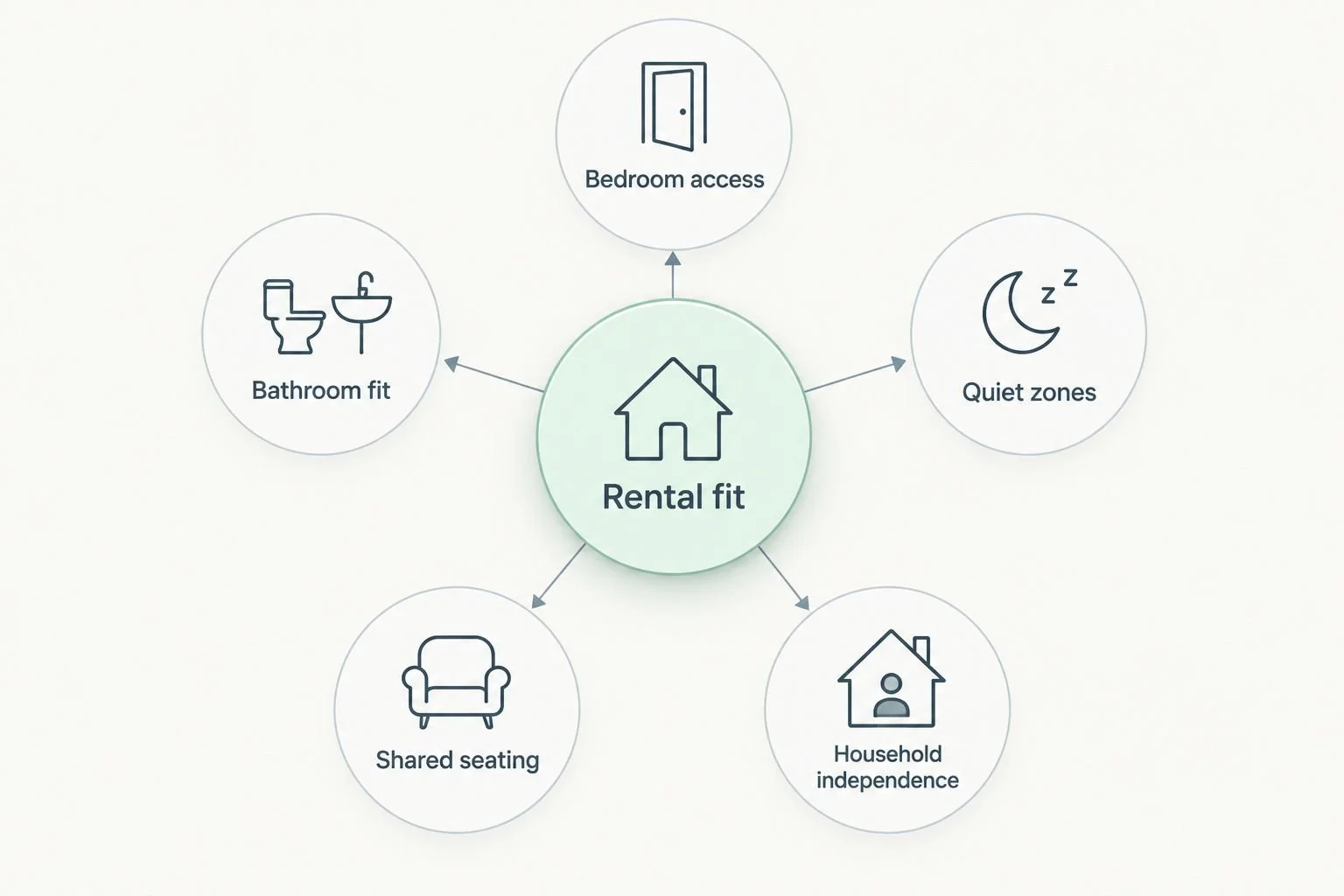
Choose the layout around the people using it, not the headline guest count.
Rental layouts at a glance
The order below favors shared time without requiring every generation to keep the same schedule. These are booking categories to investigate, not claims that a particular property offers them.
Single-level home with separated bedrooms
Best for: Mixed mobility and different bedtimes
Standout feature to verify: Essential rooms on an accessible route
Key limitation: One floor does not guarantee step-free access
Main house with separate casita
Best for: Relatives seeking privacy
Standout feature to verify: Independent sleeping space and suitable bathroom access
Key limitation: Separation complicates supervision and assistance
Neighboring rentals
Best for: Independent family households
Standout feature to verify: Separate daily routines near a shared meeting place
Key limitation: Proximity and gathering permissions need confirmation
Multi-level home with assigned floors
Best for: Adults comfortable using stairs
Standout feature to verify: Floor-by-floor separation
Key limitation: Essential rooms can be inaccessible to some guests
Compact home with shared living space
Best for: Families spending much of the day out
Standout feature to verify: A simple central gathering area
Key limitation: Limited separation when schedules conflict
1. Single-level home: best for mixed mobility and bedtimes
A single-level home with bedrooms away from the main living area is the strongest default for a mixed-age group. It keeps the search focused on access and sleeping arrangements rather than advertised capacity.
For your 2026 trip, identify the bedroom for the traveler with the most demanding access needs first. Then check its bathroom route, doorway details, shower arrangement, and distance from evening activity. Do not assume a ground-floor bedroom solves the entire access question.
Single-level home pros:
Essential rooms can be assessed without planning around an internal staircase.
Separated bedrooms give early sleepers an alternative to the main gathering area.
One shared home supports meals and informal time together.
Single-level home cons:
Entry steps, thresholds, or bathroom layouts can still create barriers.
An open-plan living area beside every bedroom provides little separation from noise.
Best for: Families combining young children, older relatives, and different sleep schedules.
Before booking, request the route from the entrance to the intended bedroom and bathroom. If a traveler uses a mobility aid, ask for the specific measurements that traveler needs rather than accepting a general accessibility description.
Verdict: Buy—choose this configuration first when the documented access and bedroom positions fit your group.
2. Main house with casita: best for relatives wanting privacy
A main house with a separate casita offers a distinct sleeping area outside the central household space. It suits adults who want shared meals and family time without sharing every morning and evening routine.
The word casita does not establish what is inside. Confirm whether the separate space has its own bathroom, how you enter it, and whether reaching the main house requires crossing steps, an exposed outdoor route, or a pool area.
Main house with casita pros:
A separate entrance supports different arrival and bedtime routines.
Physical separation gives one household a place to withdraw.
The main house can remain the designated gathering space.
Main house with casita cons:
A detached sleeping area is unsuitable when its occupant needs immediate assistance.
Separation from the main house complicates supervision of young children.
Best for: Grandparents, adult siblings, or another adult household seeking more independence.
Assign the casita by need and preference, not seniority. A grandparent who wants privacy is different from a grandparent who needs close overnight support; the same configuration does not serve both equally well.
Verdict: Buy—choose a casita setup for independent adults after verifying its bathroom and access route.
3. Neighboring rentals: best for independent households
Neighboring rentals let each household maintain its own sleeping arrangements and daily routine. This configuration works when being together means planned meals and outings rather than occupying the same building throughout the stay.
For 2 households, write down which home hosts shared meals before either booking is finalized. Confirm that the host permits the intended visitors and gatherings; a reservation at one home does not establish permission to use another as a group venue.
Neighboring rentals pros:
Each household has a separate place to sleep and decompress.
Different waking times do not require everyone to use the same kitchen.
Families can divide quiet time and social time more deliberately.
Neighboring rentals cons:
Separate bookings introduce coordination and cancellation complications.
Nearby map locations do not prove a convenient or accessible walking route.
Best for: Adult siblings traveling with their own children or households with sharply different routines.
Confirm the exact relationship between the homes, not just their neighborhood descriptions. Check entrances, crossings, parking arrangements, and permission for your proposed shared activities. One suitable home does not compensate for a second unsuitable booking.
Verdict: Hold—book only after proximity, group-use permissions, and both households' requirements are confirmed.
4. Multi-level home: best for adults comfortable with stairs
A multi-level home can separate sleeping groups by floor. It belongs on your shortlist when every traveler can use the necessary stairs comfortably and the room assignments make sense without frequent changes.
For a 2026 family gathering, do not assign rooms based only on which floor looks most private. Locate the kitchen, shared seating, bathrooms, and outdoor access as well. A traveler whose bedroom is downstairs still faces a problem if the essential shared spaces are upstairs.
Multi-level home pros:
Different floors provide a clear way to assign household sleeping zones.
Adults can choose greater separation from the main gathering area.
A documented floor plan makes room allocation straightforward.
Multi-level home cons:
Stairs can exclude relatives from bedrooms or shared activities.
Moving between floors complicates nighttime assistance and child supervision.
Best for: Adult groups and families whose members are comfortable with the property's stairs.
Ask where every essential room sits before treating extra floors as an advantage. If anyone needs to avoid stairs, select this configuration only when their bedroom, suitable bathroom, and necessary shared spaces are all on an appropriate route.
Verdict: Skip when essential spaces require stairs that any traveler cannot use comfortably.
5. Compact shared home: best for an outings-first trip
A compact home with a central living space suits a family that expects to spend much of the day elsewhere and is comfortable sharing close quarters. The appeal is a simpler home base, not an assumed financial advantage.
Confirm the actual beds and sleeping locations. If the living room doubles as a sleeping area, decide when that room stops being shared space; late conversation and someone's bedtime cannot occupy the same room independently.
Compact shared home pros:
One central space makes shared meals and daily planning straightforward.
A smaller set of rooms makes sleeping assignments easy to review.
Close shared space suits relatives who actively want frequent interaction.
Compact shared home cons:
Light sleepers have fewer options when other guests stay awake.
A living-room sleeping arrangement removes shared space at bedtime.
Best for: Families with compatible routines and an itinerary centered on outings.
Write down the arrangements for 1 bedroom at a time, including who uses each bed and bathroom. Stop if the plan depends on someone accepting a sleeping arrangement they have not agreed to.
Verdict: Buy only when everyone accepts the sleeping plan and the limited quiet space.
How these rental configurations are ranked
The ranking prioritizes bedroom access, bathroom suitability, quiet sleeping space, and the ability to spend time together. Household independence breaks the tie when relatives need different daily routines.
This is a layout-based decision guide, not a property inspection or a review-score ranking. La Quinta Retreat appears as a research resource, not as a verified match for any configuration described here.
Which rental configuration should you choose?
Choose a single-level home with separated bedrooms as your default. Move to a casita configuration when independent adults want privacy, or neighboring homes when separate households need separate routines.
Before committing to your 2026 booking, complete these 3 checks:
Assign beds: Name each sleeper and identify the actual room or shared space they will use.
Trace routes: Follow the least-mobile traveler's route between arrival, bedroom, bathroom, meals, and shared activities.
Confirm rules: Obtain written answers about occupancy, visitors, gatherings, and any feature essential to your decision.
Use La Quinta Retreat alongside this checklist, not instead of it. The best rental is the one your whole family can use as intended.
FAQ
What's the best layout for Indio vacation rentals for multi-generational trips?
A single-level home with separated sleeping zones is the strongest default for a mixed-age family. Confirm entry access, bathroom suitability, and bedroom positions before choosing an individual property.
Is a casita better than keeping everyone in one house?
A casita is better for independent adults who want privacy, not for every family. Verify its bathroom, entrance, and route to the main house, especially when someone needs assistance.
How many bedrooms does a multi-generational family need?
Base the bedroom requirement on agreed sleeping arrangements rather than the advertised guest count. Assign every traveler a bed and identify which households are comfortable sharing before you book.
Does single-level mean a vacation rental is accessible?
No, single-level does not establish accessibility. Entrance steps, thresholds, doorway dimensions, and bathroom arrangements still need to match the traveler's requirements.
Can we rent neighboring houses and gather in one of them?
Gather in one rental only when its host permits your intended visitors and activities. Confirm the relevant occupancy and gathering rules for each reservation before booking.
Should we choose a pool or an extra bedroom?
Choose the bedroom when it resolves an essential sleeping need. Consider a pool after the sleeping plan, access requirements, and supervision arrangements work for your family.
How should we compare rental costs for a family trip?
Compare the complete booking terms for your actual dates and group. Check the current total, applicable charges, cancellation conditions, and whether the sleeping arrangements meet your needs.
One last thing
Ask each household one question before sharing your shortlist: What would make this stay difficult for you? You will get more useful answers than asking whether everyone likes the photographs.
Record those answers beside the room assignments. An early bedtime, an unsuitable shower, or discomfort with stairs deserves attention before optional amenities enter the discussion.